
Hearing loss is often called a slow injury. Unlike a cut or a broken bone, it does not announce itself in the moment. It builds quietly over years of exposure, and by the time most people notice something is wrong, the damage is already done. For those working in the building and construction industry, that risk is very real.
Most claims for occupational hearing loss come from labourers and tradespeople, typically those in their mid-to-late fifties who have spent decades on the tools. The cumulative nature of noise-induced hearing loss is precisely what makes it so easy to underestimate.
Why audiometric testing is now mandatory for apprentices
Under WHS Regulation 58, audiometric testing is required for workers who are frequently required to use personal protective equipment to protect them from the risk of hearing loss associated with noise that exceeds the exposure standard. Construction is firmly in that category, and the requirement is not a formality. It exists because early detection genuinely changes outcomes. Identifying changes in hearing at the start of a career, rather than decades later, gives apprentices the chance to take protective action before irreversible damage occurs.
Audiometric testing must be provided within three months of a worker commencing work where hearing protectors are required. Regular follow-up tests must then be carried out at least every two years.
At Master Builders Apprenticeship Services, compliance with this requirement is now fully embedded in our process. All apprentices undergo audiometric testing at commencement and then again every two years throughout their apprenticeship. This means every MBAS-employed apprentice is being monitored consistently over the course of their training.
Our testing program in numbers
Over recent months, MBAS has coordinated audiometric testing across multiple locations to ensure broad coverage for our apprentices and team. Testing has been carried out through an authorised external provider, with clinic sessions held in Bankstown, Alexandria and Blacktown, as well as at the MBA office in Wollongong and our Norwest training facility. To reach apprentices across the state, we have also coordinated sessions in Ulladulla, Nowra, the Jindabyne region, the Northern Beaches, Gosford and Kincumber.
To date, 92 MBAS-employed apprentices have completed their assessments, alongside 3 teachers from Norwest and 10 MBA team members. All apprentices who were due for testing have completed it within the required timeframes, with the exception of those currently on workers compensation and therefore unavailable. Testing is ongoing, with further sessions continuing to be scheduled.
Understanding the risk on site
Hazardous noise affects the functioning of the inner ear and may cause temporary hearing loss at first. With further exposure, the ear gradually loses its ability to recover and the hearing loss becomes permanent. Permanent hearing loss results from the destruction of hair cells in the inner ear, and these cells cannot be replaced or repaired by any presently known medical treatments or technology.
The WHS Regulations set the exposure standard for noise at an average of 85 dB(A) over an eight-hour period, or a peak noise level of 140 dB(C). To put that in practical terms, a circular saw cutting hardwood typically operates at around 94 dB(A), meaning a worker could exceed the daily exposure standard after just two hours of use without appropriate hearing protection. Many construction workers regularly encounter noise levels well above this threshold throughout a standard shift.
The decibel scale is logarithmic, meaning an increase of 3 dB represents a doubling of sound energy. Every 3 dB increase in noise level can cause the same damage in half the time. This is why brief, repeated exposure to tools such as circular saws, jackhammers and powder-actuated tools still causes cumulative damage over time, even when each individual exposure seems short.
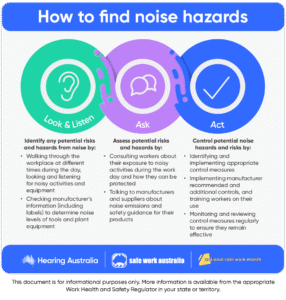
Assessing Noise Infographic from Hearing Australia
A message for host employers and builders
While audiometric testing is a mandatory obligation for apprentices working in noisy environments, the broader responsibility for managing hearing risk sits with everyone on site. Under section 19 of the WHS Act, a person conducting a business or undertaking must eliminate risks arising from hazardous noise, or if that is not reasonably practicable, minimise those risks so far as is reasonably practicable.
In practice, this means working through a hierarchy of controls before relying solely on hearing protection. Substituting quieter equipment, isolating noise sources, and applying engineering controls are all more effective long-term measures than PPE alone, which relies on consistent human behaviour and can be the least effective approach when used in isolation.
That said, when hearing protectors are required, consistency of use matters enormously. Removing personal hearing protectors for even short periods significantly reduces their effective protection. A worker wearing a hearing protector for a full eight-hour day receives up to 30 dB of maximum protection, but one hour without the protector causes that protection level to fall to just 9 dB.
If you are a host employer or builder, it is worth considering what hearing health practices look like within your business. Are your workers wearing appropriate PPE consistently? When did they last have their hearing checked? These are not complicated questions, but they are ones that can make a significant difference to the long-term health of everyone on your team.
What you can do
Wearing hearing protection every time, not just when it feels necessary, is the single most effective step any tradesperson can take. Beyond PPE, regular hearing tests provide a baseline and allow for early identification of any changes in hearing threshold levels.
Workers should be given the results of their audiometric testing accompanied by a written explanation of the meaning and implications. If any changes are identified, that is the signal to review what controls are in place and whether more can be done.
Hearing loss is largely preventable. With the right habits and the right support, the industry can do much better at protecting the people who build it.
If you are a Master Builders apprentice and have not yet completed your audiometric test, contact your field officer to get booked in.